
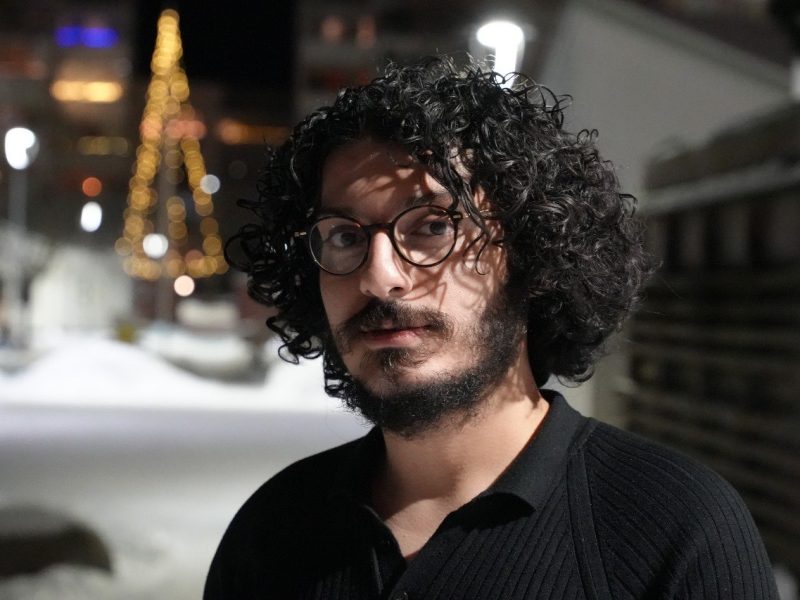
In Sweden, I have freedom of expression. I can write and perform all my words and poems freely. I am not afraid of being arrested by the Iranian authorities, and this greatly enhances my creative freedom.
Background and Inspiration
Can you share your journey from Southern Iran to becoming a composer and sound designer in Sweden? What inspired this transition?
I grew up immersed in the rich musical traditions of Southern Iran, but my true calling has always been to give a voice to the voiceless. During my years living under systemic oppression, my music served as a testament to the injustices I saw and felt every day. My art is inseparable from my life; it is born from the struggle for equality. Now, in the open creative landscape of Sweden, I have found the freedom to broaden my horizons and translate my message into music without boundaries
Fusion of Cultures
Your music blends Western rock with Eastern microtonal systems. How do you approach this fusion, and what does it mean to you artistically?
The fusion of Eastern and Western music, including the use of microtonal elements on the electric guitar, represents coexistence and equality among humans for me. This is the way I have found to express this vision through my music.
Microtonal Guitar
You’ve engineered a custom microtonal electric guitar. Could you explain how this instrument enhances your musical expression?
This particular guitar allows me to combine authentic Eastern music with Western music, rather than merely imitating an Eastern musical style. Since I am also an Iranian setar player, it enables me to apply setar techniques on the electric guitar.
Creative Process
What is your typical creative process when composing music for films or your band, Fractured Horizon?
I wait for the melody to come to me in my head, and then I try to play it. I start expanding that melody, experimenting with different instruments and rhythms. I create the climaxes of a piece of music based on that melody and refine it carefully.
Influence of Persian Music
How does the Persian Radif influence your work, and in what ways do you translate its “lost intervals” into contemporary music?
I find commonalities between Iranian instrumental music and Western music and combine them where they overlap the most. For example, on an emotional level, I express feelings of grief and sadness caused by disaster through Iranian instrumental music.
Fractured Horizon
Can you tell us more about your band, Fractured Horizon, and how it serves as a sonic laboratory for your experiments in sound?
The name Fractured Horizon actually captures our process perfectly. About a year ago, I met the guys during a gig, and we felt an immediate spark to experiment and build something new together.
For me, this band has become a true sonic laboratory. It’s a platform where I can step outside my own head and create alongside fellow musicians who challenge and inspire me. It’s no longer just about ‘my’ music; it’s about how we push each other’s boundaries and blend our different perspectives into a single sound. I’m grateful for that.
Contribution to Film
Your short film “Lek Med Mig” has been well-received. What are some challenges you faced while scoring the film, and how did you overcome them?
Surely as the first time composing for a short film was a challenge, but I liked the idea, and for me to come in touch with the storyline of the film and making it into my music was a new experience, which I enjoyed. I had to adapt my way of making music to the story and playing with those feelings.
Recent Achievements
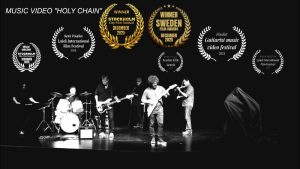
Your music video recently won the Best Music Video award at the Stockholm City Film Festival. What does this recognition mean to you?
Since the Holy Chain music video addresses the violation of women’s and children’s rights in Iran, I feel that I was able to bring the voices of those who are being oppressed to an international audience. This award motivates me to work even harder to bring the voices of oppressed people to the world through music.
Cinematic Storytelling
How do you view the relationship between music and visual storytelling in your projects?
I see music as a core part of visual storytelling. It adds emotion to images, helps express things that cannot be shown visually, and gives deeper meaning to a scene. In my work, music helps turn visuals into an emotional experience that connects with the audience.
Cultural Bridge
You describe your work as a cultural bridge. What do you hope to communicate to audiences through your music?
With the music I create, which incorporates different cultures and melodies, I want to show that no human, race, or culture is superior to another. We, the people of the world, complement each other like puzzle pieces through our cultures, art, and everything we share.
Future Projects
Are there any upcoming projects or collaborations that you’re particularly excited about?
I recently created a piece about the massive massacre of the Iranian people over two days, which will be released soon. At the same time, I am preparing with my band, Fractured Horizon, to perform our protest pieces live.
Advice for Emerging Artists
What advice would you give to young musicians and filmmakers looking to explore and blend different cultural sounds?
I would tell young artists to explore deeply, listen to the stories behind each sound, and honor its origin. Don’t be afraid to experiment, blend traditions, and use music to express memory, emotion, and personal truth. Cultural fusion is not just a technique—it’s a way to connect people and tell stories that matter.
Artistic Challenges
What are some of the biggest challenges you’ve faced in your artistic career, and how have they shaped your work?
When I wanted to add microtonal notes to my guitar, traditional Iranian music purists opposed the idea and claimed that I was destroying the sanctity of Iranian music. However, this opposition did not stop me. It took me two years to modify my guitar to accommodate microtonal notes, and playing this custom instrument ultimately shaped my musical style and made my playing distinct from everyone else.
Impact of the Swedish Arts Scene
How has being part of the Swedish arts scene influenced your music and creative expression?
In Sweden, I have freedom of expression. I can write and perform all my words and poems freely. I am not afraid of being arrested by the Iranian authorities, and this greatly enhances my creative freedom.
Personal Connection
Finally, what personal message or feeling do you hope your audience takes away from your music and films?
My entire effort is to help the audience understand the story behind my notes, to grasp the events I create music about—such as the feelings conveyed in the music video “Holy Chain,” which addresses the violation of women’s and children’s rights and forced underage marriage—and to understand how difficult and unbearable such conditions can be.
