

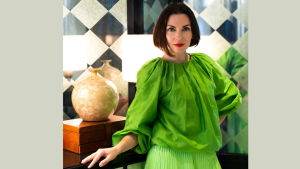
I love the freedom of experimental film. It permits you to create without following the rules. It forces you to be brave and to trust your own vision as an artist and director. Yana Yakimova
Congratulations on winning the Best Experimental Film Award! How does it feel to receive such recognition for My Hidden Archetypes?
Thank you. I am overjoyed to receive this award—especially if you knew the full story behind the film.
My background is in music. I was a well-known electronic music and jazz singer in Russia, but I always dreamed of the film industry, even though I never studied at a proper film school. My first documentary happened almost by accident in 2019 in Japan, and I didn’t know I would continue this path as an award winner.
And the most surprising part? My Hidden Archetypes was never meant to be a film.
The concept of six core archetypes was born 12 years ago, when I started writing in a diary about my whole life. After years of writing, I realized I had lived through many different roles/archetypes, changing my names, looks, behavior, and even the cities/countries I lived in—all in an attempt to adapt, to fit into society.
That’s how my almost-finished book took shape. Then, I got the idea for a play with projection mapping on the walls. Different characters representing suppressed inner energies would appear on walls, in mirrors, or in paintings during my performance.
I filmed all these characters in vertical resolution specifically so I could cut them out for projection mapping. I made them very bright and visually distinct for the stage.
But I couldn’t find a media artist to help make the play happen. So, with the footage I already had, I pivoted and created a concept for an immersive exhibition: six different rooms, each one dedicated to an archetype, with its own music, sounds, colors, objects, and even scent. The president of the Art Therapy Institute in Hong Kong, Monica Wong, loved the idea and invited me to present the exhibition at a conference in Beijing. But in the end, it proved too complex and expensive for the organizers. With only three weeks left until the conference, they had to say no.
I was disappointed, but I never give up. I told them, “OK, then I will create a film for you.”
I wrote a monologue and recorded it at home immediately. I found a talented editor, explained the concept, and he figured out how to transform my vertical footage into a horizontal, cinematic landscape. I had just one week to create the music. I did it myself, with help from a couple of musicians, singing all the parts. When the film was finished, I couldn’t believe we had made it in just three weeks.
The film is powerful simply because it’s my personal story. My core belief is about letting all your archetypes, characters play out, not suppressing them, and letting each one speak its truth—even if it’s painful. even if it’s scary.
You wore multiple hats for this film—director, writer, producer, and lead actress. Which role did you find the most challenging and why?
I was also the composer. (smiling) To be honest, everything came easily. The most difficult part was directing myself. It’s incredibly challenging to act and then check each take and quickly decide if it works because, as an actress, you have to pour all your energy into the performance. You can’t truly see yourself from the director’s perspective in the heat of the moment.
Can you describe your creative process when developing the narrative for My Hidden Archetypes?
Writing is my passion. Often, when I write, I have no idea where it will lead me. I do it intuitively, just following inner impulses. It’s like channeling. Because the main concept was already ingrained in me and the footage was ready, the monologue wrote itself in just a couple of hours.
The film delves deep into the exploration of identity and archetypes. What themes were most important for you to convey?
Society imposes norms on how we should behave as a mother, wife, boss, or good daughter. To fit in, we suppress our true feelings. We often hide parts of ourselves, not allowing ourselves to experience anger or desire, and these energies become trapped inside. If they don’t find a way out, they can create mental and physical illness. There are many healthy ways to express suppressed emotions. One of them is through art. That is also my work—I conduct workshops and trainings on how to become whole by letting all your archetypes be seen and acknowledged through writing, singing, acting, and movement.
What message do you hope audiences take away from My Hidden Archetypes?
When I first discovered all these different archetypes within myself, I was afraid to share it. I thought something was wrong with me. But later I realised that this is normal. Everyone has different roles/archetypes inside them. Some people have more, some less. It’s absolutely okay to have them. It’s essential to know them and let them play out healthily so you can become the fullest version of yourself.
The visual style of the film is striking. What was your vision in terms of cinematography, and how did you achieve that?
A friend of mine, a director, suggested I could have made the visuals less striking, more ethereal. But as I mentioned, this footage was originally intended for a stage play. It needed to be that symbolic and visually bold for the audience to grasp the idea immediately.
Your performance is both powerful and vulnerable. How did you prepare for such an emotionally demanding role?
I simply played myself. All of these characters are facets of me. I know them intimately because I’ve spent years discovering them, communicating with them, trying to understand how this inner world works. The key was to accept all of them. Take the Queen, for example. She represents the Ego—a complaining, controlling, grumpy woman. Seeing that part of myself, allowing it to exist with all its judgments, watching it without trying to change it, and letting it be grumpy—and then transforming that energy when necessary—is truly game-changing.
You explore the integration of the feminine and masculine in the film. Why do you believe this balance is essential for self-discovery?
Oh, that’s my favorite topic. Ancient teachings propose specific percentages of masculine and feminine energy for men and women. But in the modern world, those boundaries are disappearing. Men are more in touch with their feminine side, and women are embracing their masculine side by, say, building businesses or lifting weights. The LGBTQ+ community would see this very differently. So, I can’t dictate what the perfect balance is for any individual.
What I can say is that a person must have a healthy relationship with both energies. Don’t deny or refuse either one. Fully accept your masculine and your feminine sides. Let your Animus (the masculine inner figure) be the protector of your Anima (the feminine inner figure). Make them love each other. This is the key. Without this internal harmony, a person cannot feel whole. And it’s not about percentages.
How much of your own life experiences influenced the story and characters in the film?
As I’ve said, all the archetypes are my own characters. And I personally believe that these six—Inner Child, Rebel, Queen, Mother, Anima, and Animus—are the basics for every woman. There can be more, but these are fundamental. Even if a woman doesn’t have children or can’t have them, she still possesses the Mother archetype. She needs to use that energy to nurture and soothe her own Inner Child. The capacity for unconditional love exists in every woman. But we have to learn to direct that love inward first, to accept all our parts.
Collaboration is key in filmmaking. How did you work with your team to bring your vision to life?
I was so fortunate to find the best team. The director of photography immediately connected with the idea and contributed great concepts for colors and shadows for each archetype. The makeup artist was phenomenal with her work. The editor understood my vision perfectly from our very first meeting. And post-sound production went quickly because he’s known me for so long. I believe in giving people the freedom to express their creativity. Even though my inner Queen can be a bit controlling, I tried my best to stay open and relaxed about other people’s ideas. If something was truly different from what I envisioned, I learned to just accept it and see where it led.
What was the most surprising or enlightening moment you experienced during the making of this film?
When the film was finished, I cried while watching it. In that moment, I felt that all my struggles as an artist living in Asia for 12 years, facing misunderstandings, were finally over. I had created something truly meaningful, something that could have a real impact and help people feel better. For the first time, I felt I could finally be heard. And thank you for recognizing my art.
What future projects do you envision for yourself after this film? Are there any new themes or stories you wish to explore?
I am currently finishing my book. It’s a deep dive into the different archetypes and how I lived through each one—changing my name, my city, my appearance, my behavior, my music —all in the journey to become whole and happy.
My goal is to turn it into an incredible TV series. I am looking for a producer.
What role do you think experimental films play in the larger context of cinema?
I love the freedom of experimental film. It permits you to create without following the rules. It forces you to be brave and to trust your own vision as an artist and director.
Lastly, what advice would you give to aspiring filmmakers who wish to tackle personal or experimental narratives?
When I look at the contemporary art scene, I often feel there is a lack of deep meaning. That’s why I’m so grateful to festivals like yours, which prioritize meaning.
These days, many artists are chasing trends and trying to please the audience. They forget that as artists, we have tremendous power. Through our art, we have the ability to positively influence people.
The true goal of art, and of every artist, is to tell stories and create deep, resonant meanings—something that will inspire others, help them grow, and ultimately, contribute to making humanity better and happier.
